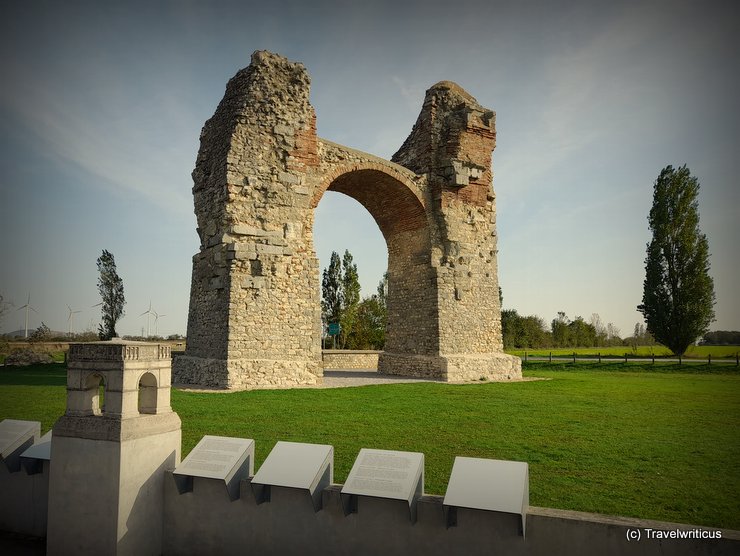
The Horseshoe Tower (Hufeisenturm) in Tulln remains from the ancient military camp Comagena. The Roman name originated from an equestrian unit descending from the region of Commagena.
You only see what you know (Goethe)

The Horseshoe Tower (Hufeisenturm) in Tulln remains from the ancient military camp Comagena. The Roman name originated from an equestrian unit descending from the region of Commagena.

The Ankeruhr in Vienna is a clock in a gangway between two buildings on the Hoher Markt Square (1. District). It displays every hour a different personality who has played a role in the history of Vienna. [German]

This water tower in Wels was built in 1577/1579 by Wolfgang Khranlachner. Watchmaker Clement Rench designed the water pump inside the tower. Artist Niclas Linkh created the colourful façade painting.

Seeschloss Ort impresses with its location on a tiny island in the Upper Austrian Traunsee Lake. The castle became known through a TV series and the mysterious disappearance of one of its owners. Today, it houses a restaurant visitors reach by a bridge. [German]

This sundial on a residential building shows two depictions of the Styrian city of Bruck an der Mur. In the upper part of the mural, you see Landskron Castle and the former city walls. [German]

At the classic car museum in Poysdorf (Oldtimerclub Poysdorf), I saw this Volkswagen Schwimmwagen. The amphibious four-wheel drive off-roader dates back to 1943. At that time, it served the German Wehrmacht.

Palais Trautson, designed by Johann Bernhard Fischer von Erlach, is considered one of the most beautiful Baroque palaces in Vienna. For many years it served as the seat of the Royal Hungarian Guards. Today it houses the Austrian Ministry of Justice. [German]

This piece is one of the most famous ancient Roman tombstones in Austria. It is the depiction of a coach. You find it in the wall of the Marienkirche, a church in Maria Saal. Though it doesn’t show a mail coach, it is sometimes called so.

Ferdinand Raimund (1790-1836) was an Austrian actor/dramatist and a master of the Viennese Posse. Watching his plays give insights into the life of the first half of the 19th century in Vienna. [German]

The Kunsthaus, dating back to 2003, shows exhibitions of contemporary art. Because of its architecture, it is generally known as the “Friendly Alien”. The form of an irregular bubble offers the possibility to enjoy bulky sculptures in an appropriate space. [German]

This mosaic at a building in Vienna reminds pedestrians of an ancient gate (porta principalis dextra) that stood here in the 1st century. It was part of the Roman fort Vindobona, the nucleus of modern Vienna.

There are a lot of signs in Graz mentioning the string A.E.I.O.U. Habsburg Emperor Frederick III used these vocals to mark his buildings while staying in Graz. The meaning of this string is still unsolved. [German]