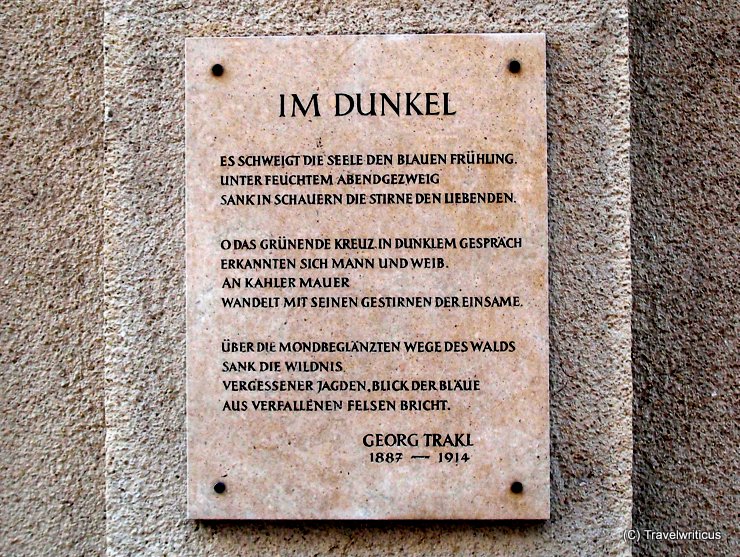
A famous son of Salzburg is not only Wolfgang Amadeus Mozart but also the poet Georg Trakl. The Salzburg-born author lived the first 21 years of his life in this city. You see boards with his poems scattered all over the central town.
You only see what you know (Goethe)
A famous son of Salzburg is not only Wolfgang Amadeus Mozart but also the poet Georg Trakl. The Salzburg-born author lived the first 21 years of his life in this city. You see boards with his poems scattered all over the central town.
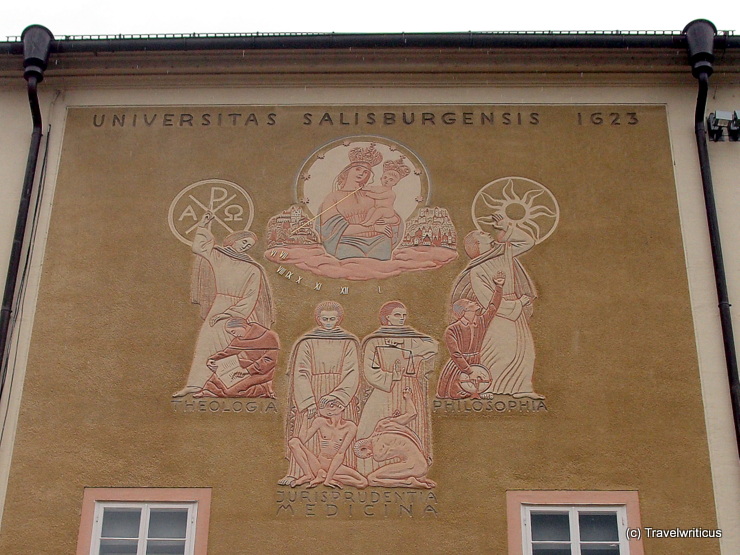
This fresco with a sundial is located on a wall of the old university at the Max-Reinhard-Platz. It was created by Georg Jung (1899-1957). The depictions refer to the university founded in 1622. [German]
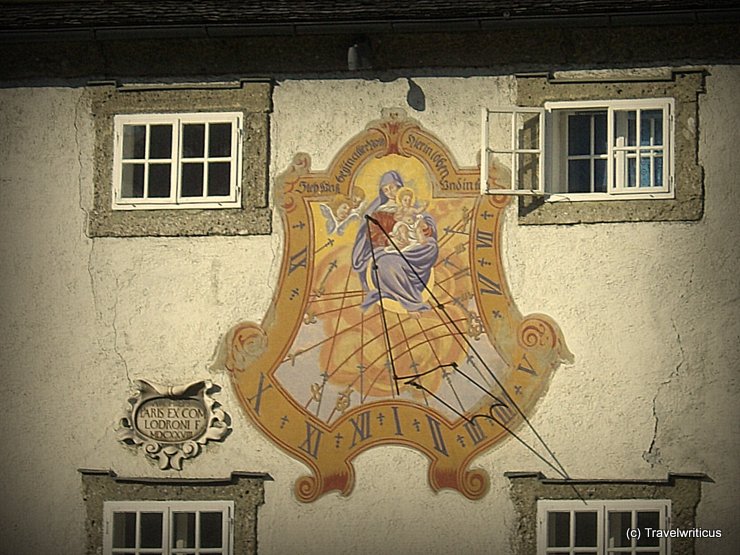
The Zeugwartstöckl in Salzburg is the surviving guardhouse of the demolished Michaelstor (Michael Gate). It stands between Mozartplatz and Rudolfskai. You see this sundial, dating back to 1628, on the facade facing Mozartplatz. [German]
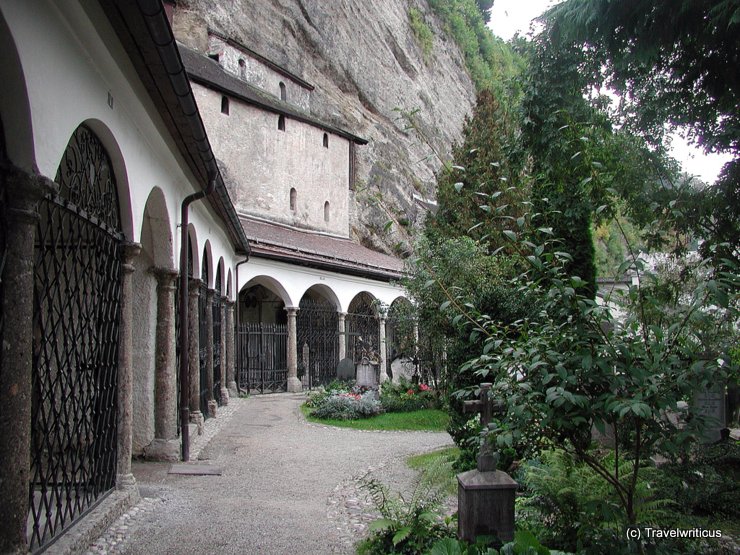
The cemetery of St. Peter (Petersfriedhof) is not only one of the oldest cemeteries of Salzburg but was also a set in the American movie ‘Sound of Music’. The small windows along the rock are part of the so-called catacombs.
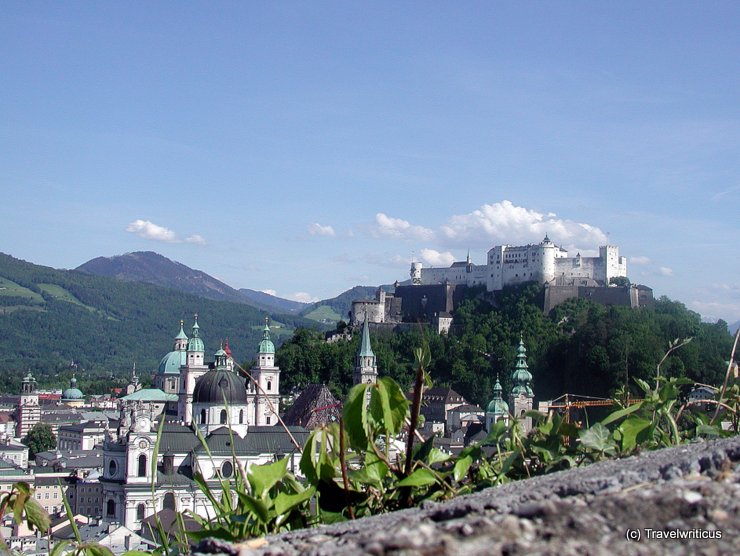
A narrow panoramic path leads in front of the Museum der Moderne in Salzburg. From there, I had this formidable view over the rooftops of Salzburg and Hohensalzburg Fortress.
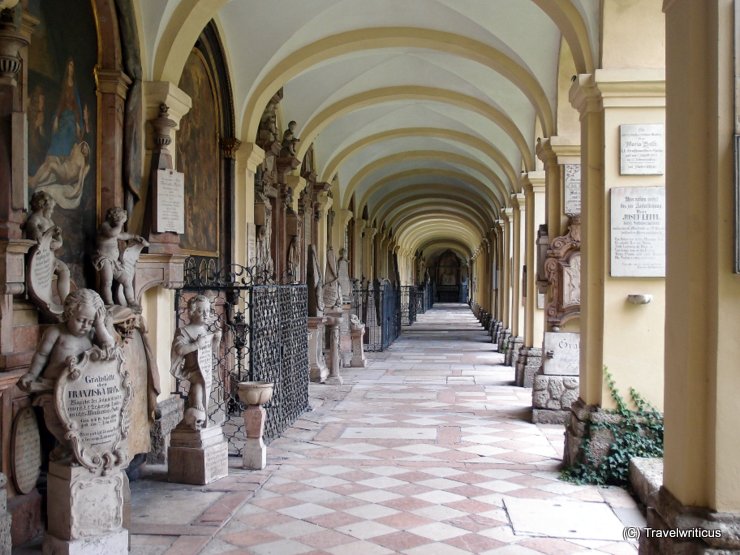
The Sebastian’s Cemetery (Sebastiansfriedhof) dates back to the end of the 16th century. It was built in the style of an Italian campo santo. You find here the graves of Mozart’s widow and Paracelsus, founder of the discipline of toxicology. [German]
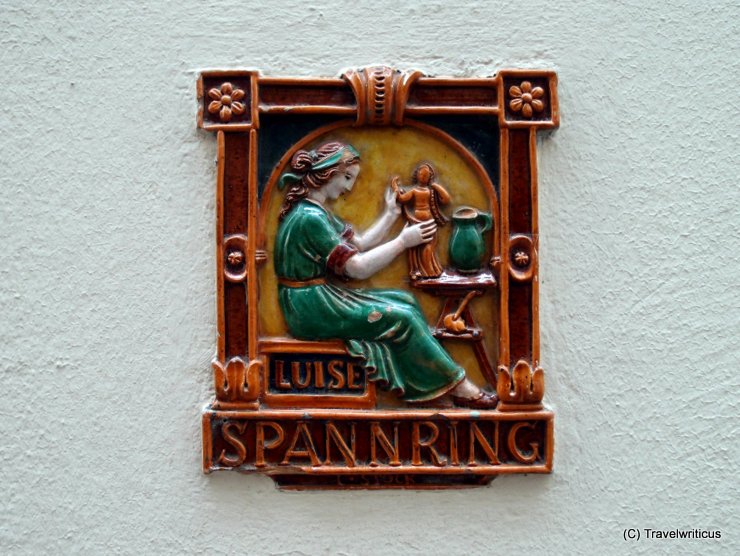
This ceramic tile in the Steingasse is reminiscent of the ceramicist Luise Spannring (1894-1982). In Salzburg, she became known as the founder of a ceramic school. Her works are exhibited in numerous museums. In the Salzburg Museum, you see ceramic nativity scenes from her. [German]
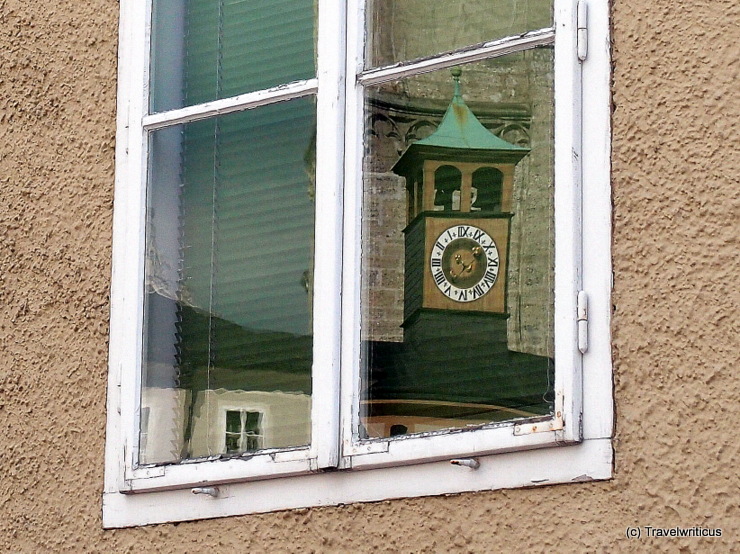
This public clock, reflected in a simple window, is located on top of a walkway connecting the Franciscan monastery (Franziskanerkloster) with the Franciscan church (Franziskanerkirche) in Salzburg. [German]
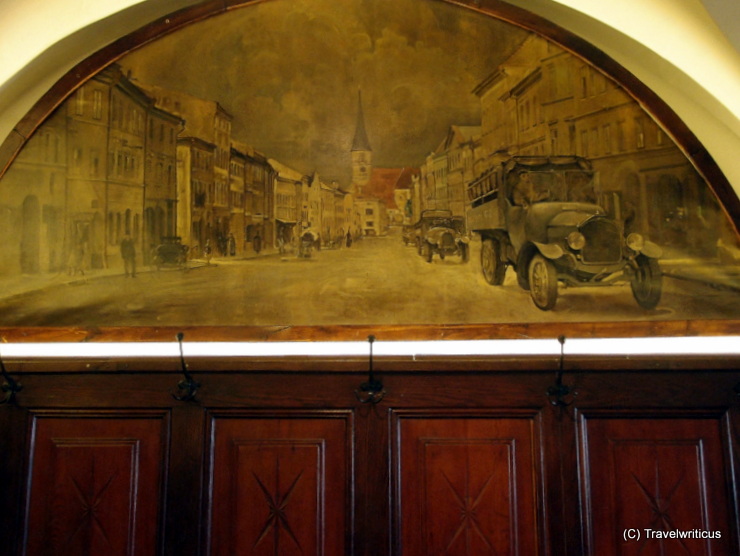
The Braumeisterstube is part of the Sternbräu Restaurant in Salzburg. This restaurant was first mentioned in 1542 and offers several old and modern rooms for having a glass of beer or a traditional meal. [German]
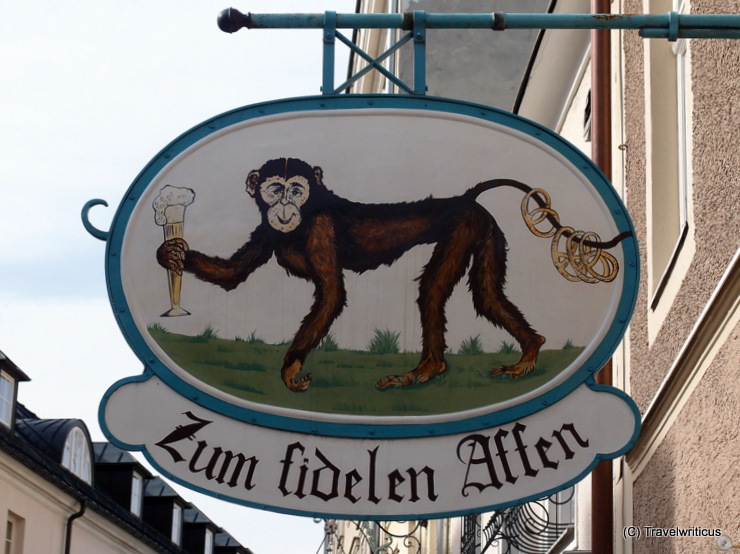
You find this inn sign on a traditional restaurant in Salzburg. The name “Zum fidelen Affen” literally means “Merry Monkey”.
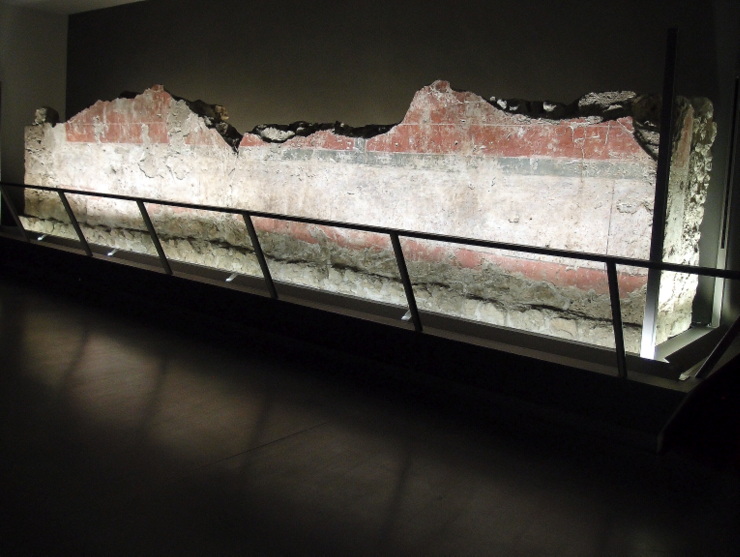
While walking from the Salzburg Museum to the Panorama Museum through the Panorama Passage, I came across the remains of an ancient Roman mural. It was discovered during an excavation in 2003.
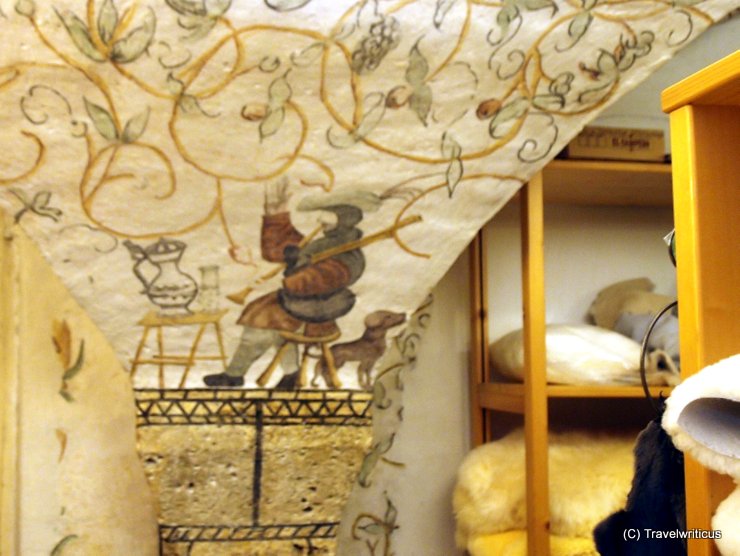
Since 1422, tanners have been working at the address Lederergasse 5 in Salzburg. At the same address, there is still a shop run by the family of Schliesselberger selling goods made of leather.